
Aluminium Modular Compressed Air Piping System
Ahuja Group designs, supplies and installs modular aluminium compressed air piping systems for manufacturing plants across India — from CNC machine shops to large automotive assembly facilities. Our aluminium piping for compressed air is available from DN20 to DN250, rated to 20 bar, with a 10-year installation warranty. Turnkey service from site survey and pipe sizing through to pressure testing and commissioning documentation.
What is an aluminium compressed air piping system?
An aluminium compressed air piping system is the distribution network that carries compressed air from the compressor to every point of use across a manufacturing plant — pneumatic tools, machines, cylinders, and instruments. It consists of a ring main header, branch lines, drop legs, condensate drain points, isolation valves, and push-fit fittings. Aluminium modular systems use push-fit connections — no welding, no threading — making installation 3 to 4 times faster than GI or MS pipework.

Table of Content
- Why the Piping System Determines Your Compressor's Real-World Performance
- Is Your Compressed Air System Losing Money Right Now?
- The Problem with GI and MS Compressed Air Pipelines
- 5 Hidden Cost Chains Active in Your MS/GI System Right Now
- Your Pipeline Decision Has a 25-Year Price Tag
- Aluminium Modular Piping — The System That Eliminates Every Problem
- Compressed Air Piping Materials — Which is Right for Your Plant?
- A Complete Compressed Air System — From Source to Point of Use
- How Ahuja Group Designs and Installs Your Aluminium Compressed Air Pipeline Systems
- Trusted by Customers Across India — Every Major Industry
- Industries Ahuja Group Serves
- How Plants Typically Work With Us
- What We Need to Design Your System and Give You an Accurate Quote
- Frequently Asked Questions
- Get a Free Compressed Air System Design
- What is an Aluminium Compressed Air Piping System?
120+ Projects
10 States
55+ Years
4,000+ Customers
10-Year Warranty
Why the Piping System Determines Your Compressor's Real-World Performance
Plant managers spend Rs 15 to 50 lakhs on a screw air compressor — and rarely measure how much of that capacity actually reaches the production floor. In a typical plant running 10 to 15 year old GI compressed air pipework, internal corrosion reduces the effective bore by 15 to 25 percent. The compressor compensates by generating higher pressure — consuming 7 to 8 percent more energy per extra bar. In a 37 kW plant running 16 hours per day at Rs 8 per unit, this adds Rs 3 to 5 lakh per year in unnecessary energy costs.
This is a distribution problem, not a compressor problem. Replacing the compressor does not fix it. Replacing the pipeline does.
15–25%
GI Bore Reduction at Year 10–15
₹3–5L
Annual Wasted Energy Cost
+7–8%
Energy Cost Per Extra Bar
18–36M
Typical Payback Period
Is Your Compressed Air System Losing Money Right Now?
Many compressed air problems are not compressor problems — they are pipeline problems. If your plant has been running MS or GI pipework for more than 5 years, ask yourself these six questions:
Has working pressure at machine points dropped below your compressor outlet pressure?
Pressure drop across the distribution system — the first sign of internal scaling or undersized headers.
Do you hear hissing sounds or detect air escaping at joints or older pipe sections?
Threaded and welded joints in MS/GI develop micro-leaks. 20 to 30 percent of generated air may be leaking undetected.
Are pneumatic valves, cylinders, or solenoids failing or being replaced more than expected?
Rust particles travelling downstream destroy seals and valve seats. Contamination damage is silent and cumulative.
Does the compressor run almost continuously, even during periods of low production?
A compressor compensating for pressure drop and leakage runs longer than it should — driving energy bills and maintenance costs.
Is your pipeline difficult or costly to extend when your production layout changes?
MS/GI requires cutting and re-welding for every modification. Layout changes generate scrap and require hot work permits.
Has your pipeline been repainted in the last 3 years to cover external rust?
External rusting in MS/GI is cosmetic evidence of internal corrosion. Repainting cost and downtime are ongoing, not one-time.
If you answered yes to two or more — your pipeline is costing you money today. Ahuja Group provides a free compressed air audit.
Book yours: +91-70235-40310 →The Problem with GI and MS Compressed Air Pipelines
GI and MS compressed air pipes fail through a predictable six-stage chain.

Corrosion begins immediately
GI pipe's internal zinc coating degrades within 3–5 years under compressed air condensate. MS pipe rusts from the first year.
Scale accumulates
In a 2-inch GI main at year 10, internal scale reduces the effective bore by 15–25%. Continuous and progressive.
Turbulent flow replaces laminar
Above 6 m/s, flow becomes turbulent. A 15% bore reduction can cause 30–40% higher pressure drop.
The compressor works harder
To maintain 7 bar at usage points, the compressor runs at 8.5–10 bar. Each additional bar increases energy consumption by 7–8%.
Air quality degrades
Rust particles and scale fragments travel downstream — reducing seal life and creating contamination failures in food, pharma, and electronics environments.
Full replacement
At year 12–15, GI systems typically require complete replacement — at a cost that exceeds the original installation.
Ahuja Group has replaced GI and MS compressed air networks in automotive, pharmaceutical, and textile plants among others across India. Post-installation measurements consistently show 40–60% pressure drop reduction and 15–25% compressor running hour reductions.
5 Hidden Cost Chains Active in Your MS/GI System Right Now
These five cost chains do not run one after another — they run simultaneously. Every year a degraded MS/GI pipeline operates, all five are compounding your operating cost.
| Cost Chain | Cause | Mechanism | Effect | Result | Financial Impact |
|---|---|---|---|---|---|
| Rust & Scaling | Internal rust forms from year 1 | Scale narrows bore over time | Friction and turbulence increase | Pressure drops at every machine | 6–8% more power per bar lost |
| Leakage & Waste | Threaded joints age and loosen | Micro-leaks and pinholes form | Air escapes undetected | Compressor runs longer | 20–30% of compressed air wasted |
| Contamination | Rust particles enter airstream | Reach valves, cylinders, tools | Accelerated seal wear and seizure | Frequent component replacements | 15–25% higher maintenance spend |
| Moisture & Condensate | Condensation inside pipeline | Water enters the airstream | Wet air reaches tools and processes | Product defects, tool corrosion | Rejects, rework, production downtime |
| Undersized Bore | Pipeline sized for original demand | Production capacity added over time | Air velocity exceeds 6 m/s | Pressure drop and moisture carryover | Quality failures and compressor overload |
Your Pipeline Decision Has a 25-Year Price Tag
The initial cost of a GI pipeline is lower. The 10-year total cost — energy wasted, air leaked, components replaced, pipes repainted — is 2 to 3 times higher. Aluminium costs more on day one. It costs less every single day after that.
(Initial + Energy + Leakage + Maintenance)
The Solution
Aluminium Modular Piping — The System That Eliminates Every Problem
Aluminium modular compressed air piping is the system that directly addresses every failure mode of MS/GI pipework. No internal corrosion — the bore is smooth on installation day and stays smooth for 25 years. No joint leakage — O-ring seals deliver zero leakage for the system lifetime. No hot work — assembly requires no welding, no threading, no fire permits. Fully modular — any section opens
and reconfigures without scrap.
Ahuja Group installs aluminium compressed air piping systems using Quickair — manufactured by Canares Automation Pvt. Ltd., Bengaluru, India’s only manufacturer of modular pipe fittings. The Quickair aluminium air pipe is available in DN20 to DN250 — each aluminium compressed air pipe is seamless 6063-T5 alloy with blue powder coat (RAL 5012), rated to 20 bar standard and 40 bar for high-pressure applications.
For full Quickair product specifications, system variants, and catalogue downloads, see our Quickair Aluminium Piping page.

Compressed Air Piping Materials — Which is Right for Your Plant?
| Criteria | MS / GI Steel | PPR | Stainless Steel | Composite | Aluminium Modular★ RECOMMENDED |
|---|---|---|---|---|---|
| Leakage Risk | ✗ High — joints age & rust pinholes; weld quality variable | ✗ Medium — thermal cycling causes joint failure over time | ✗ Leakage at threaded joints; weld skill dependent | ~ O-ring joints; micro-leakage may develop with vibration & age | ✓ Zero — sealed push-fit / crimped joints. No weld, no thread, no degradation |
| Internal Rust / Corrosion | ✗ Severe — moisture causes rust build-up & bore loss over time | ✓ No rust | ✓ No rust | ✓ No rust | ✓ Zero corrosion — guaranteed for life |
| Air Quality & Contamination | ✗ Rust particles damage valves, cylinders & instruments | ~ Microplastic particles may enter airstream as inner surface degrades | ✓ Clean air | ✓ Clean air | ✓ ISO 8573-1 certified — zero contamination risk ever |
| Energy Efficiency & Pressure Drop | ✗ Rust scaling narrows bore — ~6–8% more power per bar lost. Turbulent flow increases friction losses. | ✗ Weld beads at joints & leakage losses reduce efficiency | ~ Good — smooth bore, good flow | ~ Good — minor losses at compression fittings reduce end-point pressure | ✓ Smooth full-bore — laminar flow, full pressure at every end point. Stable efficiency across 25-year life |
| Cost — Initial (Material + Install) | ~ Low material cost but high installation labour cost | ~ Low-moderate material; moderate installation cost | ✗ High material cost; highest installation cost | ~ Low-moderate material; moderate install — competitive on small diameters | ~ Moderate material cost; low installation cost (fast, no specialist labour). Overall competitive |
| Cost — 10-Year Total (TCO) | ✗ High — energy, leakage, contamination damage, repainting. Typically 2–3× aluminium | ✗ High — energy losses, weld maintenance, no warranty | ~ Moderate — good system but high initial cost; no warranty | ~ Moderate — O-ring leakage maintenance; limited warranty | ✓ Lowest TCO — zero leakage, rust & repainting costs. 10-yr warranty. Competitive initial cost |
| Joining Method, Installation Speed & Skill | ✗ Threaded / welded joints. Slow — fire permits, heavy pipe, skilled welders needed. High labour cost & long shutdown. | ✗ Fusion / butt welding. Slow — skilled welders, joint cure time, fire permits. Heavy pipe needs more manpower. | ✗ Welded / threaded. Slowest — heaviest material, highest skill requirement & labour cost. | ~ Compression fittings. Faster than steel — lighter pipe, no hot work or permits required. | ✓ Push-fit (DN20–63) / Crimped (DN40–250). Fastest — no hot work, no permits, no specialist labour. Minimal shutdown. |
| Expandability & Modifications | ✗ Cut & re-weld every change — costly, disruptive, production shutdown | ✗ Not reusable — all material scrapped on modification | ✗ Difficult and expensive to modify | ~ Partially modular — fittings may be damaged on reopening | ✓ Fully modular — open, extend, reuse, relocate freely without damaging fittings |
| Service Life & Warranty | 8–12 yrs (corrosion-limited). No warranty. | Shorter life in compressed air. No warranty. | 25+ yrs if maintained. No warranty. | 15–20 yrs. O-rings may need replacement. Limited warranty. | ✓ 25-yr design life · 10-yr manufacturer warranty |
| External Maintenance | ✗ Repainting every 2–3 years — ongoing cost & labour | ~ UV surface degradation outdoors | ✓ No painting needed | ✓ No painting needed | ✓ Zero external maintenance — ever |
| Fire Safety | ✓ Non-combustible | ✗ Combustible — melts/burns; not for fire-risk areas | ✓ Non-combustible | ✗ Combustible outer layer — not for fire-risk environments | ✓ Non-combustible — safe for pharma, food, chemical & regulated plants |
| Pressure Rating | High — weld quality dependent | Up to 20 bar | Very high | Up to 16 bar typical | ✓ 20 bar standard / 40 bar option |
| Size Range | Wide — ½" to 12"+ | Wide range | Wide but very costly | ✗ Limited — DN20 to DN50 typically | ✓ DN20 – DN250 — full range for mains & sub-mains |
| Recyclability | ~ Low — rusted scrap fetches poor price | ✗ Minimal scrap value | ~ Good scrap value | ✗ Composite/multilayer — difficult to separate & recycle | ✓ High — strong commodity scrap value. 100% recyclable |
| Thermal Expansion | Low — manageable | ✗ High — sagging & joint failure risk | Low — manageable | ~ Moderate — more support points needed | ✓ Low coefficient — dimensionally stable |
A Complete Compressed Air System — From Source to Point of Use
Zone 1 Generation & Treatment

- Screw Air Compressor
- Aftercooler
- Micro Filters (pre, post, final, carbon)
- Refrigerated / Desiccant Dryer
- Auto Drain Valve
- Air Receiver / Storage Tank
- Moisture Separator
- Oil-Water Separator
Zone 2 Distribution

- Aluminium Pipeline
- Aftercooler
- Push-fit & Crimped Fittings
- Isolation Valves
- Drop Lines, Supports & Accessories
Zone 3 Point of Use

- FRL Units
- PU Tubing & Fittings
- Quick Release Couplings
- Pressure & Flow Sensors
Because Ahuja Group knows both the compressor output and the end-point demand, we size your distribution system to deliver the right pressure at every machine — not an estimate.
How Ahuja Group Designs and Installs Your Aluminium Compressed Air Pipeline Systems
Ahuja Group delivers aluminium compressed air piping as a complete turnkey service.
Site Survey and Demand Assessment
We visit your facility, map all compressed air usage points, measure compressor capacity and operating pressures, and assess the existing distribution infrastructure. Provided at no charge.
Pipe Sizing and CAD Layout Design
We calculate pipe diameter for every section — header, branches, drop legs — and produce a CAD layout for review before any material is ordered.
Material Supply
We supply Quick Air aluminium pipes, fittings, valves, manifolds, condensate drains, and mounting hardware. Standard sizes up to 63 mm dispatched same-day from our Jaipur stock. Larger diameters on short lead time.
Installation
Our Quick Air-certified crew (installation team) assembles the system using push-fit or integrated compression fittings. No welding, no threading, no hot work permits — installation proceeds in live production areas without shutting down the facility. A 100-metre ring main typically takes 3–5 days.
Pressure Testing and Commissioning
We pressure test the completed network to 1.5× working pressure, check every joint individually, and provide commissioning documentation: pressure test certificate, as-built CAD layout, and Quick Air installation warranty documentation.
What Ahuja Designs For — Not Just Installs
Correct pipe sizing for distance, flow and pressure at every end point
We calculate the minimum pipe diameter for every section of ring main and every branch — ensuring the furthest machine receives air at the specified pressure even at peak demand.
Ring main vs dead-end — optimised for your plant layout
We specify a closed loop where it is the better design for your plant footprint. We do not apply a single template to every plant.
Future expansion points planned and marked at installation
We identify where your production is likely to grow and leave accessible tee connections at those points — so adding a new machine costs a fitting, not a pipe replacement.
Isolation zones for maintenance without full shutdown
We place isolation valves so any section of the system can be taken offline for maintenance while the rest of the plant continues running.
Condensate drainage slope — moisture managed at the pipeline
Every run of pipe is installed with the correct gradient to drain condensate to collection points. Moisture problems are solved in the design, not patched later.
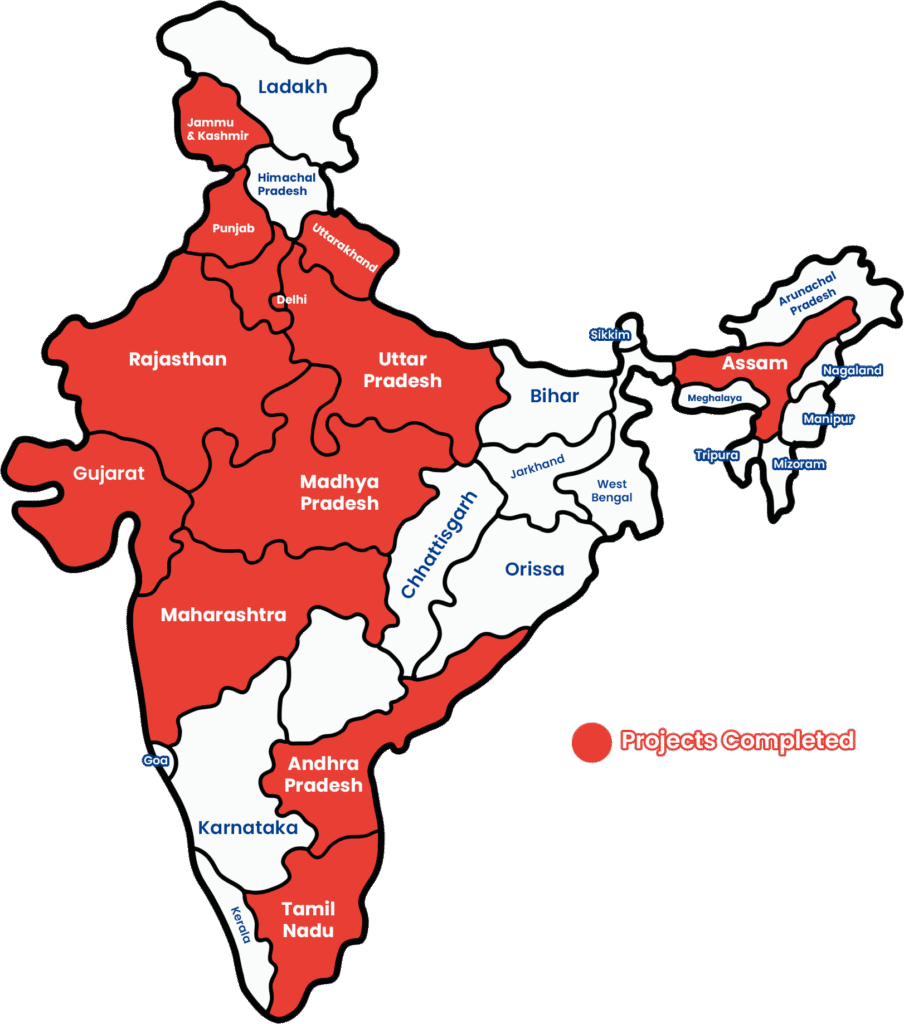
Trusted by Customers Across India — Every Major Industry
Ahuja Group has completed 120+ compressed air piping projects across 10 states. Our installation teams travel to project sites — your geography is not a constraint.
Industries Served Across States by Ahuja Group
For greenfield projects, Ahuja Group coordinates with the main EPC contractor on installation scheduling to align compressed air commissioning with the overall plant startup timeline.
Industries Ahuja Group Serves
Every company shown below runs Quick Air aluminium compressed air pipeline installed by Ahuja Group. Automotive assembly lines, power equipment manufacturers, heavy engineering plants — the same system, designed and commissioned by our team.
Automotive


Power


Solar

Textiles

Stone

Printing

Plastic


Ceramics

Food

Engineering

Cables


Consumer Durables

Furniture


How Plants Typically Work With Us
Three types of projects. Which one is yours?
New Plant Installation
Situation
You are setting up a new factory or production facility. The compressor room is planned but not yet installed.
What We Do
We work from your factory layout drawing — AutoCAD file preferred, but a dimensioned hand sketch also works. We specify the compressor capacity, design the complete distribution system, size every pipe section, and install before your machines are commissioned. No late-stage retrofitting.
Expansion of Existing System
Situation
Your production capacity is growing. You are adding machines, a new production bay, or a new building.
What We Do
We assess your current system pressure at the furthest existing point, calculate what additional demand your expansion adds, and design an extension that maintains pressure across the full network. If the existing header is undersized for the expansion, we tell you that
before you order.
Replacement of Old GI/MS Pipeline
Situation
Your existing GI or MS pipeline is more than 8 years old. Pressure is dropping. The compressor runs longer than it should.
What We Do
Free compressed air audit first — we measure actual pressure drop, identify leakage points, and document air quality. We then design the replacement system to your current plant demand, not the original specification. Installation is completed in live production where possible.
What We Need to Design Your System and Give You an Accurate Quote
Compressed air pipeline quotations cannot be done from a phone call alone. Here is exactly what to prepare — or let us visit and collect this information ourselves.
1. Your Compressor Details
- Number of compressors installed or planned
- Make, model, CFM or LPM output, and HP or kW rating
- Operating pressure in bar
- Air receiver tank capacity in litres
- Refrigerated or desiccant dryer — make and capacity
- Outlet connection size at compressor discharge
2. Your Plant Layout
- Overall factory floor dimensions
- Compressor room location relative to production floor
- AutoCAD file preferred — a dimensioned hand sketch also works
- Location of all planned machine usage points marked on drawing
- Ceiling height and routing obstructions
3. Usage Points and Air Demand
- Total number of drop points — machines requiring compressed air
- Required pressure at each machine in bar
- Type of connection needed: hose, rigid drop, or quick coupler
- Any points requiring ISO 8573 Class 1 clean dry air
- Future expansion areas to incorporate into the design now
4. Site and Installation Conditions
- Project type: new installation, expansion, or replacement
- Permissible installation hours: day shift, weekend, or planned shutdown
- Scaffolding availability
- Safety requirements: PPE mandated, work permit procedures
- Civil permission: drilling, wall penetrations, anchor points
Call or WhatsApp: +91-70235-40310 | Email: [email protected]
Frequently Asked Questions

What is the best material for compressed air piping in a manufacturing plant?
For most Indian manufacturing plants, aluminium modular pipe is the correct specification. It does not corrode internally or externally, maintains a permanently smooth bore throughout its 25-year design life, requires no welding, installs 3 to 4 times faster than GI, and carries a 10-year manufacturer warranty. GI pipe costs less on day one and significantly more every year after that — through energy waste, leakage, maintenance, and replacement. The right choice depends on your operating pressure, air quality requirement, and budget. Contact Ahuja Group for a material recommendation based on your specific plant.
What is the standard colour code for compressed air pipelines in India?
Under IS 2379, the standard colour for compressed air is Sky Blue. Quickair aluminium pipes are factory-finished in RAL 5012 blue to comply with this standard. Consistent colour coding prevents misidentification during maintenance — critical in plants running multiple compressed gases. Ahuja Group follows IS 2379 on all compressed air pipeline installations and includes colour-coded pipe clips and identification labels as standard.
What causes pressure drop in a compressed air piping system?
The three main causes are: undersized pipe diameter (pipe sized for original demand, not current demand), internal corrosion and scale in GI or MS systems reducing the effective bore, and excessive bends or fittings creating turbulence. A correctly sized aluminium ring main maintains less than 0.2 bar pressure drop from header to furthest point. Every 1 bar of pressure drop increases compressor power consumption by 6 to 8 percent.
What is a ring main compressed air system and why is it better than a dead-end layout?
A ring main is a closed-loop compressed air header that feeds from the compressor and returns to the same point, creating a complete loop. Air can reach any drop point from two directions simultaneously — so if demand is high on one side, air flows from both directions to maintain pressure. A dead-end layout feeds in one direction only, causing pressure to fall progressively toward the far end. For most manufacturing plants larger than 100 metres, a ring main is the correct design.
How much does it cost to install an aluminium compressed air piping system in India?
Installation cost depends on system size, number of drop points, pipe diameter, and site conditions. As a reference: a small machine shop with 20 to 30 usage points and 150 metres of ring main typically costs Rs 3 to 6 lakh installed. A mid-size manufacturing plant with 50 to 80 points and 300 metres of ring main runs Rs 8 to 18 lakh. A large automotive or pharma facility with 100+ points is quoted on site assessment. Ahuja Group provides a no-obligation quotation after a free site visit. Contact [email protected] or call +91-70235-40310.
Does Ahuja Group provide a warranty on compressed air pipeline installations?
Yes. Ahuja Group provides a 10-year installation warranty on every aluminium compressed air piping system we install. The Quickair pipe and fittings carry an additional 10-year manufacturer warranty from Canares Automation Pvt. Ltd. against manufacturing defects. On handover, we provide a pressure test certificate (tested to 1.5 times working pressure), as-built CAD layout, and Quickair warranty documentation.
Can an existing GI compressed air pipeline be upgraded to aluminium without a plant shutdown?
How do I get a free compressed air audit from Ahuja Group?
Contact us at [email protected] or call and WhatsApp +91-70235-40310. Share your plant location, type of industry, and existing compressor make and capacity. We will schedule a site visit at a time convenient for your plant. The audit includes: measurement of actual pressure at compressor outlet and furthest usage point, leakage detection survey, air quality assessment, and a written report with recommendations and estimated ROI on upgrading to aluminium. No charge, no obligation.
Get a Free Compressed Air System Design
Share your plant dimensions, number of usage points, and operating pressure — or let us visit and assess it ourselves. Free site survey, pipe sizing calculation, and aluminium compressed air pipeline system layout design. No obligation.
Request a Free Assessment
What is an Aluminium Compressed Air Piping System?
A compressed air piping system is the permanent distribution network that carries compressed air from your compressor to every point of use across your factory — pneumatic tools, machines, cylinders, actuators, and instruments. It consists of a ring main header, branch lines, drop legs, condensate drain points, isolation valves, and fittings.
An aluminium compressed air piping system uses seamless aluminium alloy pipe with push-fit or integrated crimped fittings. Unlike GI or MS pipework, aluminium does not rust or scale internally. Its bore remains smooth throughout its life, maintaining the pressure drop performance it was designed to at day one. Aluminium’s light weight — one-third of steel — allows easy overhead installation.
A correctly designed system keeps pressure drop from the compressor outlet to the furthest usage point below 0.2 bar at full plant demand. Achieving this requires correct pipe sizing, ring main topology, and condensate management — all covered in the system design sections below.
Maximum pressure drop — compressor to furthest point
Weight vs steel — lighter, easier overhead installation
Design life — zero planned maintenance