
Compressed Air Piping System for Industrial Manufacturing Plants
A complete guide to compressed air piping systems — materials, design principles, GI/MS failure modes, and what an aluminium modular system delivers. For Indian manufacturing plants.
Table of Content
- What is a Compressed Air Piping System?
- Why the Piping System Determines Your Compressor's Real-World Performance
- Is Your Compressed Air System Losing Money Right Now?
- The Problem with GI and MS Compressed Air Pipelines
- Compressed Air Pipeline Colour Code — IS 2379 Indian Standard
- Compressed Air Piping Materials — Which is Right for Your Plant?
- Ahuja Group Installs Aluminium Compressed Air Piping Systems Using Quickair
- Ahuja Group Compressed Air Pipeline Projects — 30+ Cities Across India
- How Ahuja Group Designs and Installs Compressed Air Piping Systems
- Industries Ahuja Group Serves for Compressed Air Systems
- Frequently Asked Questions
- Get a Free Compressed Air System Design
What is a Compressed Air Piping System?
A compressed air piping system is the distribution network that carries compressed air from the compressor to every point of use across a manufacturing plant — pneumatic tools, assembly machines, cylinders, actuators, painting equipment, and instruments. It consists of a main ring header, branch lines, drop legs, condensate drain points, isolation valves, and the fittings that connect them.
The piping system is not a passive component. It is the infrastructure that determines how much of the energy your compressor generates is actually delivered to your production floor — at the right pressure, at the right flow, and in the right air quality. A well-designed compressed air piping system makes the compressor work efficiently. A poorly designed or degraded system forces the compressor to work harder, consume more energy, and deliver less.
Ahuja Group designs, supplies and installs compressed air piping systems for manufacturing plants across India — from CNC machine shops to large automotive assembly facilities. Our preferred pipe material is Quick Air modular aluminium — the details of why are on our aluminium compressed air piping system page.
Why the Piping System Determines Your Compressor's Real-World Performance
Plant managers spend ₹15–50 lakhs on a quality screw compressor. It is maintained on schedule, loaded correctly, and selected with the right capacity for the plant’s air demand. What is almost never measured is how much of that capacity reaches the production floor.
In a typical Indian manufacturing plant running 10–15-year-old GI compressed air pipework, internal corrosion and scale reduce the effective bore by 15–25%. Turbulent flow in the degraded network increases pressure drop dramatically. The compressor compensates by generating higher outlet pressure — consuming 7–8% more energy for every additional bar. In a plant running a 37 kW compressor for 16 hours a day at ₹8/kWh, a 20% over-pressure situation from distribution system degradation adds approximately ₹3–5 lakh per year in unnecessary energy costs.
This is not a compressor problem. It is a distribution system problem. And it is entirely avoidable.
A new compressed air piping system, correctly sized and installed, recovers this energy loss permanently — with a payback period of 18–36 months on the full installation cost in most plants.
Key Figures
GI Bore Reduction at Yr 10–15
15–25%
Annual Wasted Energy Cost
₹3–5 lakh
Energy Cost Per Extra Bar
+7–8%
Payback Period
18–36 mo
If your plant is running GI or MS pipework more than 5 years old, it's very likely already costing more than it should in energy, maintenance, and lost pressure. Take our free diagnostic →
The Problem with GI and MS Compressed Air Pipelines
Galvanised iron and mild steel compressed air pipes fail through a predictable sequence. Understanding this sequence is essential for any maintenance manager or plant head evaluating whether to replace or maintain an existing metallic compressed air network.
Internal corrosion begins immediately
GI pipe's internal zinc coating degrades within 3–5 years under sustained exposure to compressed air condensate. MS pipe begins rusting within the first year. What follows is not an event — it is a progressive condition.
Scale builds on the pipe wall
By year 10, a 2-inch GI main can show 15–25% bore reduction from accumulated iron oxide and zinc hydroxide scale. This is not visible without cutting a pipe section open — which is why it goes undetected in most plants until the symptoms appear.
Pressure drop rises as bore reduces
The relationship is not linear — a 20% bore reduction causes a 40–50% increase in pressure drop across the same pipe length. The system begins behaving as though it is undersized, even if it was correctly sized at installation.
The compressor runs harder to compensate
Delivery pressure at the furthest usage points drops, and the compressor must generate higher outlet pressure to maintain production requirements. Energy consumption rises. Compressor running hours increase. Maintenance intervals shorten..
Air quality degrades
Rust particles and scale fragments travel downstream into pneumatic valves, cylinders, and instruments. Seal life in pneumatic components drops significantly. In food, pharmaceutical, or electronics manufacturing, contaminated compressed air creates product quality and regulatory compliance failures.
For plants on GI or MS compressed air networks older than 8 years, a compressed air audit will quantify exactly what the current system is costing — in energy, maintenance, and air quality terms. Ahuja Group provides this audit free of charge.
Now You Know What Is Happening Inside Your Pipeline — here is what to do about it.
Ahuja Group supplies and installs aluminium compressed air piping systems that eliminate
every failure mode described above. Read the full case for switching to aluminium:
Compressed Air Pipeline Colour Code — IS 2379 Indian Standard
Compressed air pipelines in Indian industrial plants are colour-coded under IS 2379 — the Indian Standard for identification of pipe contents by colour. The standard colour for compressed air is SKY BLUE (IS 2379 Group 1, Sub-group 1). This is why Quick Air aluminium pipes are factory-finished in RAL 5012 blue — the standard industrial blue for compressed air.
For plant safety and maintenance, consistent colour coding across the compressed air network prevents misidentification during maintenance — particularly important in plants running multiple compressed gases (nitrogen, CO₂, argon) alongside compressed air. Standard colours under IS 2379 for reference:
| Medium | IS 2379 Colour | Swatch | Note |
|---|---|---|---|
| Compressed Air | Sky Blue | Quick Air RAL 5012 — factory finished |
Ahuja Group follows IS 2379 on all compressed air pipeline installations. Colour-coded pipe clips, brackets, and identification labels are included as standard in our installation scope.
Compressed Air Piping Materials — Which is Right for Your Plant?
Five piping materials dominate Indian compressed air installations: aluminium modular, GI, MS,PPR, MLC Composite. Each has distinct corrosion behaviour, installation profile, and lifespan. Aluminium is the correct specification for most new plants and upgrades. The comparison below shows the key differences. For the full 12-criteria technical comparison including modularity, end-of-life value, and pressure ratings, see the Aluminium Compressed Air Pipeline page.
| Criteria | Aluminium (Modular) | GI Pipe | MS Pipe | PPR Plastic | MLC Composite |
|---|---|---|---|---|---|
| Corrosion Resistance | ✓ Zero — internally & externally | ✗ Internal rusting from Year 1 | ✗ Severe internal corrosion | ✓ No corrosion | ✓ No metal corrosion |
| Bore Quality Over Time | ✓ Smooth bore for 25+ years | ✗ Reduces 15–25% in 10–15 yrs | ✗ Severe scale buildup | ✓ Smooth bore maintained | ✓ Smooth bore maintained |
| Installation Method | Push-fit. No welding. No hot work. | Threading & welding required | Welding required. Hot work permit. | Fusion welding / socket | Compression fittings |
| Installation Speed | 3–4× faster than GI/MS | Slow — skilled welder required | Slowest — hot work + permits | Moderate | Moderate |
| Max Pressure Rating | 20 bar standard, 40 bar PN40 | Varies by schedule | High — by weld quality | 10–16 bar typically | 15–20 bar |
| Air Quality | Clean, dry, particle-free | Rust particles, contamination | Heavy contamination risk | Clean air delivered | Generally clean |
| Warranty | 10 years — manufacturer + install | None typical | None typical | Limited manufacturer only | Limited manufacturer only |
| Modularity & Expansion | Fully modular — open, extend, relocate without scrap. Zero wastage on layout changes. | Cut and re-weld every change. Shutdown required. | Weld to modify. Hot work. Scrap generated. | All material scrapped on modification. | Partially modular — fittings may be damaged on reopening. |
| End-of-Life Value | 100% recyclable. Strong commodity scrap value. Asset, not expense, even after 25 years. | Rusted scrap — low value. | Rusted scrap — low value. | Negligible scrap value. | Difficult to separate layers. Minimal scrap value. |

Aluminium Air Pipeline
Quick Air
Aluminium compressed air pipelines offer corrosion-resistant, leak-proof solutions ensuring efficient, safe, and long-lasting air distribution in industries.

Aluminium Composite Air Pipeline
UNIPRO
Composite air pipelines provide durable, corrosion-resistant, air distribution with easy installation, high flow efficiency, and long service life.

PPR Air Pipeline
KPT
PPR air pipelines provide cost-effective, corrosion-resistant, and lightweight air distribution with low noise, easy installation, and long-term reliability.

Stainless Steel Air Pipeline
Quick Air
Stainless steel modular air pipelines offer high strength, corrosion resistance, and hygienic air transfer with quick installation and long durability.
Ahuja Group installs Quickair aluminium compressed air piping systems — full product specifications, project references, and a free site assessment are on our aluminium compressed air pipeline page.
DN20 to DN250, rated to 20 bar, 25-year design life, 10-year installation warranty. 120+ installations across 10 states. Free site survey for all projects.
Pan-India Installation Capability
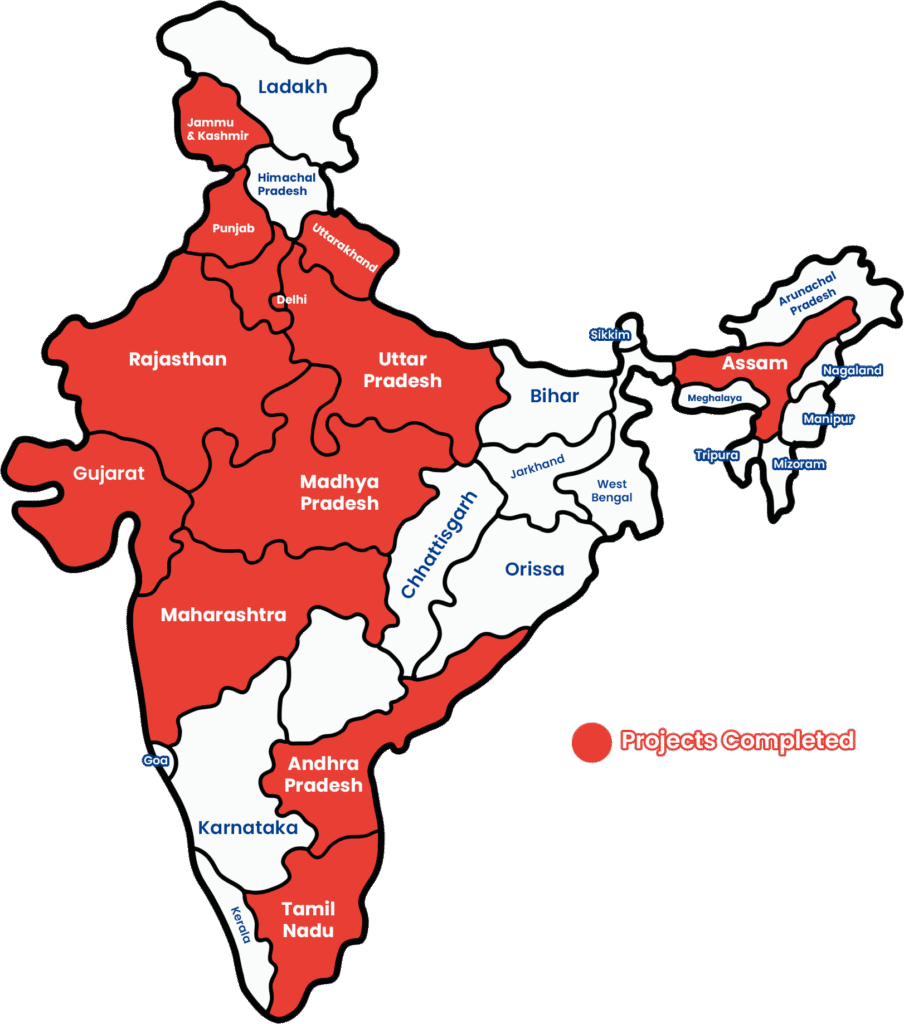
Ahuja Group has completed 120+ compressed air piping projects across 10 states. Our installation teams travel to project sites — your geography is not a constraint.
Industrial clusters served:
For greenfield projects, Ahuja Group coordinates with the main EPC contractor on installation scheduling to align compressed air commissioning with the overall plant startup timeline.
How Ahuja Group Designs and Installs Compressed Air Piping Systems
Ahuja Group delivers compressed air piping as a complete turnkey service. We do not supply pipe and leave installation to a local contractor — we own the outcome from site survey to commissioning.
Site survey and demand assessment
We visit your facility, map all compressed air usage points, measure existing or planned air demand, and assess the compressor output. For new plants, we work from the factory layout drawing.
Pipe sizing and CAD layout
We calculate the correct pipe diameter for every section — header, branches, drop legs — and produce a CAD layout for review with your team before material is ordered.
Material supply
We supply Quick Air aluminium pipe and all associated fittings, valves, condensate drains, and mounting hardware. Standard sizes up to 63 mm dispatched same-day from our Jaipur stock.
Installation
Our Quick Air-certified crew assembles the system using push-fit or integrated compression fittings — no welding, no threading, no hot work permits. We can work in live production areas without shutting down the facility.
Pressure testing and commissioning
We pressure test to 1.5× working pressure, check every joint individually, and provide commissioning documentation including pressure test certificate and as-built layout.
Industries Ahuja Group Serves for Compressed Air Systems
For EPC contractors and project consultants specifying compressed air distribution systems, the case for aluminium over GI or MS comes down to three practical advantages: installation speed, air quality compliance, and lifecycle documentation.
Automotive and Auto Components
Paint shop ISO 8573 Class 0/1 requirements, assembly line pneumatics, body shop high-volume ring mains.
Pharmaceuticals and Biotech
GMP-compliant installation, ISO 8573 air quality documentation, validation-ready commissioning records.
Textile and Spinning Mills
High-volume overhead ring mains for pneumatic weaving and spinning operations in large production halls.
Consumer Durables and Electronics
Clean dry air for paint lines, SMT assembly, and precision testing.
Heavy Engineering and Foundry
High-volume compressed air for machine shops, fabrication areas, and foundry operations. PN40 systems for applications requiring above 20 bar.
Cement and Minerals
High-dust environments with sustained air demand for pneumatic conveying and control systems.
Printing and Packaging
Press room air quality and pneumatic clamping systems.
Frequently Asked Questions

What is a compressed air piping system?
A compressed air piping system is the distribution network that carries compressed air from the compressor to every point of use across a manufacturing plant — ring main header, branch lines, drop legs, condensate drains, isolation valves, and fittings. The design of this system determines how much of the compressor’s output is actually delivered to the production floor at the correct pressure and air quality.
What is the best material for compressed air piping in a manufacturing plant?
For most Indian manufacturing plants, aluminium modular pipe is the correct specification. It does not corrode internally or externally, maintains a permanently smooth bore throughout its 25-year design life, requires no welding, and installs 3 to 4 times faster than GI. GI pipe costs less on day one and significantly more every year after that — through energy waste, leakage, maintenance, and replacement. MS pipe corrodes faster than GI and should not be used for new compressed air installations.
The right choice depends on your operating pressure, air quality requirement, and budget. For a full material-by-material comparison including 12 criteria, see the Aluminium Compressed Air Pipeline page.
What is the standard colour code for compressed air pipelines in India?
Under IS 2379, the standard colour for compressed air pipelines in India is Sky Blue. Quick Air aluminium pipes are factory-finished in RAL 5012 blue — the standard industrial blue for compressed air. Other IS 2379 colours: Steam — Silver-Grey, Oxygen — Black, Nitrogen — French Blue, CO₂ — Grass Green.
What causes pressure drop in a compressed air piping system?
Pressure drop has four main causes: undersized pipe diameter; internal scale and rust in GI/MS pipes (progressively reducing bore); dead-end design instead of ring main (pressure drops at furthest points under peak load); and leakage at joints. In ageing GI systems, internal scale alone can cause 30–50% higher pressure drop than the design specification.
How much does it cost to install a compressed air piping system in India?
Installation cost depends on system size, number of drop points, pipe diameter, and site conditions.
As a reference:
Small machine shop — 20 to 30 usage points, 150 metre ring main: Rs 3 to 6 lakh installed
Mid-size plant — 50 to 80 usage points, 300 metre ring main: Rs 8 to 18 lakh installed
Large automotive or pharma facility — 100+ usage points: quoted on site assessment
These are indicative ranges. The primary drivers of cost are pipe diameter (determined by your compressor capacity and demand at each machine), plant footprint, and site conditions such as height and routing complexity.
Ahuja Group provides a no-obligation quotation after a free site visit. We do not quote from specifications alone — the site visit ensures the quote reflects the actual installation scope.
Contact [email protected] or call +91-70235-40310.
Get a Free Compressed Air System Design
Share your plant dimensions, number of usage points, and operating pressure — or let us visit and assess it ourselves. Ahuja Group provides a free site survey, pipe sizing calculation, and compressed air system layout design for all projects. No obligation.Call or WhatsApp: +91-70235-40310 Email: [email protected] Alternatively, if you already know you need an aluminium compressed air pipeline — see our full aluminium piping system page for Quick Air specifications, technical data, and project references.